I have been on the road a lot over the past few weeks and aside from getting ever more concerned about my rapid consumption of diesel, I have been poking around the various towns I trundle through. True, the independent wine shops face determined competition from the multiples, but independence is also a great asset - encouraging flexibility, imagination and increasingly important - ingenuity!
There are a host of other categories of independent retailers that are subject to the same pressures - but I spotted one the other day that I don't think will suffer much competition from the likes of Tesco or Aldi.....
Guns and Music - now that's a novel combination!
Monday, April 30, 2012
Thursday, March 29, 2012
Three Very Different Wines (well six actually)....
What with all the travelling and sampling at this time of year, when it comes to sitting down to open an actual bottle of wine to enjoy, the selection tends to be a bit more eclectic and the hunt is always on for something a little different.
First up was something very different! Sinead is just back from Slovenia where she has been pruning the vines. An unseasonally warm start to the year meant she was late (as far as the vines were concerned!), but all seemed good by the time she left. There was also the small matter of checking our wines that had been sitting quietly in Miro's cellar all Winter. As you can see from the picture, brining samples back on the plane isn't exactly a glamorous activity - washed and sterilised baby food jars are the best option! We had the three different Modra Frankinja (Blaufrankisch) cuvees to try: "SS (Stainless Steel)" was the cold-soaked version, "Plastic" was the one fermented in open crates and "Press" was the combined press juice from the two. Of them all, the one tasting best was the "Plastic" - normal fermentation using natural yeasts in open containers - lovely complexity. The "SS" tasted much more primary, and more "juice"-like (rather than wine). The "Press" one was tainted by baby food! They still need to undergo malolactic fermentation, so some more changes to come....
All were washed down with some of our own duck breasts - a very tasty treat!
A few nights later I was rummaging around trying to find something different an I unearthed a bottle of Baudry's Franc de Pied 2002. I'm a huge fan of all the Baudry wines, and had completely forgotten we had this. It's a relatively rare/unknown cuvee made from a parcel of un-grafted (i.e. pre-phylloxera) vines in the Clos Guillot vineyard. In short, it was stunning. This would give any Bordeaux over €100 a run for the money - yet I think it cost about €10. It could pass blind as a top elegant Graves. Must try and find a few more bottles.
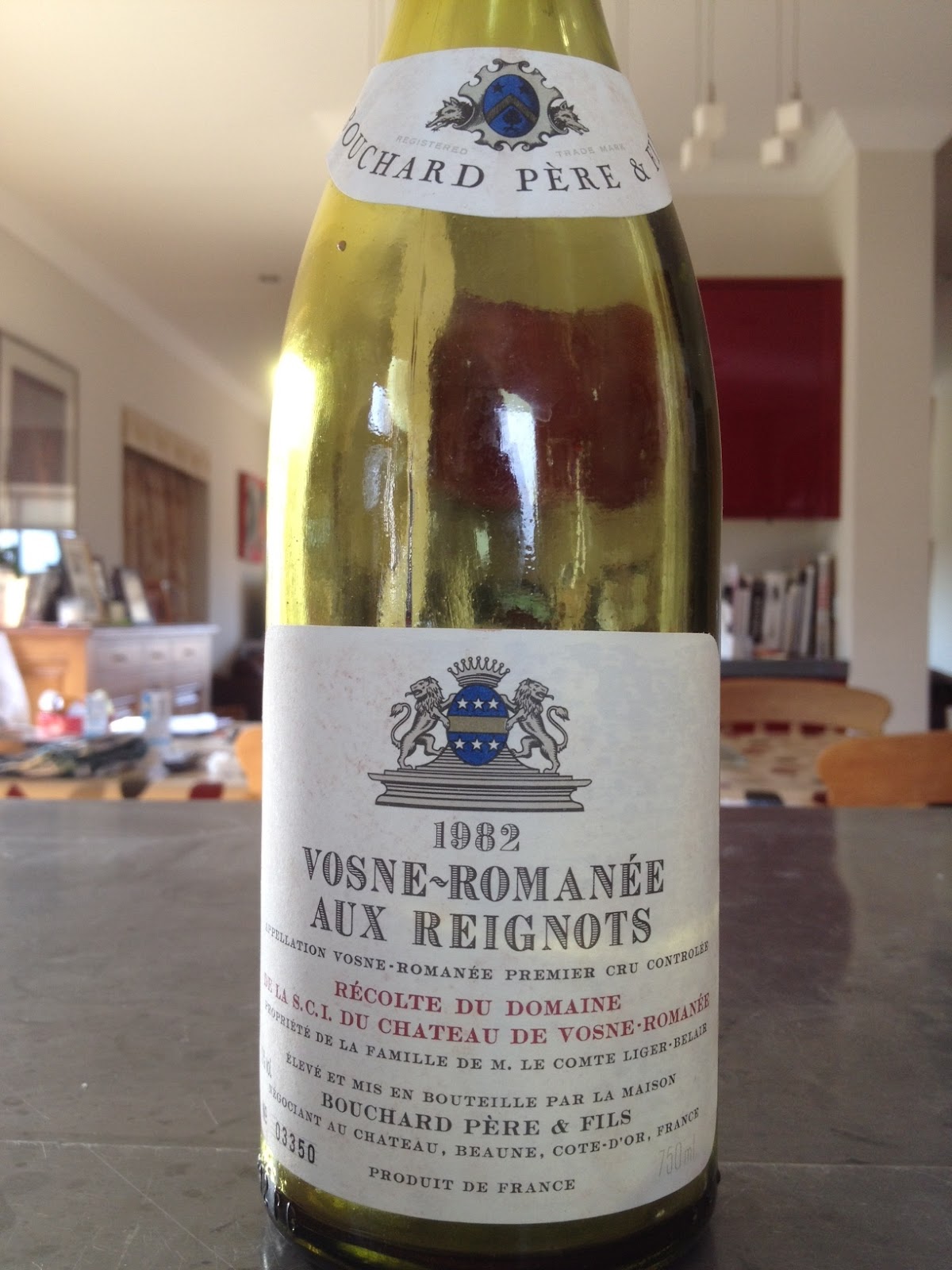
Finally, something purchased out of curiosity at auction: partly because I couldn't find anything particularly positive about the 1982 vintage in Burgundy and partly due to the combination of producer and vineyard. We have imported the wines of Louis Michael Liger-Belair and they are now amongst the most sought-after red Burgundies around. Yet many of the vineyards only returned to Louis Michel's direct control over the past decade - some of the most prestigious (including La Romanee) had been leased out to Bouchard. This particular Vosne 1er Cru "Aux Reignots" is now no longer bottled by Bouchard as the vineyard has reverted to Louis Michel - and so technically exists no more under this label. Amazingly it was in pristine condition, now fully mature, and an absolute joy to drink.
Three great reminders of the amazing diversity that wine can offer.
First up was something very different! Sinead is just back from Slovenia where she has been pruning the vines. An unseasonally warm start to the year meant she was late (as far as the vines were concerned!), but all seemed good by the time she left. There was also the small matter of checking our wines that had been sitting quietly in Miro's cellar all Winter. As you can see from the picture, brining samples back on the plane isn't exactly a glamorous activity - washed and sterilised baby food jars are the best option! We had the three different Modra Frankinja (Blaufrankisch) cuvees to try: "SS (Stainless Steel)" was the cold-soaked version, "Plastic" was the one fermented in open crates and "Press" was the combined press juice from the two. Of them all, the one tasting best was the "Plastic" - normal fermentation using natural yeasts in open containers - lovely complexity. The "SS" tasted much more primary, and more "juice"-like (rather than wine). The "Press" one was tainted by baby food! They still need to undergo malolactic fermentation, so some more changes to come....
All were washed down with some of our own duck breasts - a very tasty treat!
A few nights later I was rummaging around trying to find something different an I unearthed a bottle of Baudry's Franc de Pied 2002. I'm a huge fan of all the Baudry wines, and had completely forgotten we had this. It's a relatively rare/unknown cuvee made from a parcel of un-grafted (i.e. pre-phylloxera) vines in the Clos Guillot vineyard. In short, it was stunning. This would give any Bordeaux over €100 a run for the money - yet I think it cost about €10. It could pass blind as a top elegant Graves. Must try and find a few more bottles.
Finally, something purchased out of curiosity at auction: partly because I couldn't find anything particularly positive about the 1982 vintage in Burgundy and partly due to the combination of producer and vineyard. We have imported the wines of Louis Michael Liger-Belair and they are now amongst the most sought-after red Burgundies around. Yet many of the vineyards only returned to Louis Michel's direct control over the past decade - some of the most prestigious (including La Romanee) had been leased out to Bouchard. This particular Vosne 1er Cru "Aux Reignots" is now no longer bottled by Bouchard as the vineyard has reverted to Louis Michel - and so technically exists no more under this label. Amazingly it was in pristine condition, now fully mature, and an absolute joy to drink.
Three great reminders of the amazing diversity that wine can offer.
Friday, March 16, 2012
Fancy a Beer for St. Patrick's Day....?
As the Shamrock gets drowned around the World tomorrow, and as the tipple of choice is normally beer, how about this to convince you....
Actually, I stumbled across this by chance. But what fascinated me was that at the end of the clip, some other associated video options popped up and I had a look.
Wow - these guys have a serious chip on their shoulder... or a tongue placed very firmly in their cheek - I'm not sure which to be honest with you. You decide...
Actually, I stumbled across this by chance. But what fascinated me was that at the end of the clip, some other associated video options popped up and I had a look.
Wow - these guys have a serious chip on their shoulder... or a tongue placed very firmly in their cheek - I'm not sure which to be honest with you. You decide...
The Swirl
The Sniff
The Stall
As their website says "The main problem with wine is the taste..."
Gotta love marketing!
Happy St. Patrick's Day!
Friday, March 2, 2012
March 2012 Fine Wine Bin End Sale
We have poked around the cellar and uncovered bottles of varying age, size, origin and style - and to be very honest, all of them delicious. Once we round them all up, we take a look at them and think what we'd like to drink ourselves - and then we discount them hugely - by anywhere from 25% to 70%. Every year we always get a few of you coming back to us saying "that was delicious, do you have any more...?" - the simple answer in most instances is "No" - this is it, the single opportunity to pick up these wines at this price, and as the saying goes, "when they're gone, they're gone".
So what do we have to tempt you? Well, firstly, the majority of these are all drinking really nicely now - we have made an effort to focus on wines that you can begin to enjoy the minute they arrive. Secondly, we have tried to offer a broad range of styles and countries - we could have done all Bordeaux, but there are those of you (many, in fact) who also like to try something a little different, and this is a great opportunity. So what would I buy?
- 1999 St. Cosme Cote Rotie @ €75 - in my opinion an absolute bargain. Louis Barroul told me a while back that he only had 6 of these left in his cellar - and he owns the place! If he's reading this Blog, he can pick up another three!
- 2002 Chinons from Bernard Baudry starting @ €18 - two of his top Cuvees from a great vintage, matured for 10 years - you can't ask for much more!
- 1999 Braida Bricco dell Uccellone @ €35 - modernist Barbera from a great producer and drinking beautifully now.
- 1999 Mastroberardino Taurasi Riserva @ €31 - raved about by Jancis Robinson and singled out as one of the best examples of Aglianico around
- 2003 Pagodes de COS Magnums @ €110 - Parker released his final scores of the Bordeaux 2009 wines in the last few hours. He previously raved about Cos 2003, and has also done so about the 2009, making it effectively disappear from the market. This is the "baby" version of the 2003 - very impressive now.
- 1990 Huet le Mont Moelleux 1ere Trie @ €80 - last week saw Noel Pinguet leave the iconic Loire winery, Huet. Will amazing sweet wines like this ever be made again? A stunning wine - and still a baby!
- 1990 Raymond Lafon Sauternes @ €80 - same price, same year, different style. From the former manager of Yquem, this is complex, mature, decadent Sauternes - they practise even lower yields than Yquem!
- 2006 Meo Camuzet Marsanny @ €26 - there are plenty of heavy hitting Burgundies in there, but in terms of price/quality this is a real deal - often overlooked, but wonderful crunchy, lively Pinot.
- 2003 Moulin St. Georges Saint Emilion Grand Cru @ €48 - across the road from Ausone and with the same owner - but only about €1,000 a bottle cheaper...
- 1996 Peter Lehmann "Mentor" Shiraz @ €35 - we don't see enough aged Shiraz around, it doesn't last long enough! This is a real treat.
- 2000 Brundlmayer Riesling Zobinger Heilegenstein Trockenbeerenauslese Halves @ €40 - I just checked on-line and the average price for this comes up as €95! I'm a big dessert wine fan and this is delicious stuff.
- 2003 Istenic Prestige Brut @ €24 - if this was "Champagne" it would all be gone. Made by the country's best producer (and highly regarded internationally), this is a bargain based on place of production rather than quality. A previous Wine of the Week in the Irish Times too!
- Plenty of "treat" wines as well - Masseto 1994 @ €180, Meo Camuzet NSG 1er Cru Meurgers from the great 2005 vintage @ €95, Pape Clement 2004 @ €55
You can download the offer here: March 2012 Fine Wine Bin End Sale
So what do we have to tempt you? Well, firstly, the majority of these are all drinking really nicely now - we have made an effort to focus on wines that you can begin to enjoy the minute they arrive. Secondly, we have tried to offer a broad range of styles and countries - we could have done all Bordeaux, but there are those of you (many, in fact) who also like to try something a little different, and this is a great opportunity. So what would I buy?
- 1999 St. Cosme Cote Rotie @ €75 - in my opinion an absolute bargain. Louis Barroul told me a while back that he only had 6 of these left in his cellar - and he owns the place! If he's reading this Blog, he can pick up another three!
- 2002 Chinons from Bernard Baudry starting @ €18 - two of his top Cuvees from a great vintage, matured for 10 years - you can't ask for much more!
- 1999 Braida Bricco dell Uccellone @ €35 - modernist Barbera from a great producer and drinking beautifully now.
- 1999 Mastroberardino Taurasi Riserva @ €31 - raved about by Jancis Robinson and singled out as one of the best examples of Aglianico around
- 2003 Pagodes de COS Magnums @ €110 - Parker released his final scores of the Bordeaux 2009 wines in the last few hours. He previously raved about Cos 2003, and has also done so about the 2009, making it effectively disappear from the market. This is the "baby" version of the 2003 - very impressive now.
- 1990 Huet le Mont Moelleux 1ere Trie @ €80 - last week saw Noel Pinguet leave the iconic Loire winery, Huet. Will amazing sweet wines like this ever be made again? A stunning wine - and still a baby!
- 1990 Raymond Lafon Sauternes @ €80 - same price, same year, different style. From the former manager of Yquem, this is complex, mature, decadent Sauternes - they practise even lower yields than Yquem!
- 2006 Meo Camuzet Marsanny @ €26 - there are plenty of heavy hitting Burgundies in there, but in terms of price/quality this is a real deal - often overlooked, but wonderful crunchy, lively Pinot.
- 2003 Moulin St. Georges Saint Emilion Grand Cru @ €48 - across the road from Ausone and with the same owner - but only about €1,000 a bottle cheaper...
- 1996 Peter Lehmann "Mentor" Shiraz @ €35 - we don't see enough aged Shiraz around, it doesn't last long enough! This is a real treat.
- 2000 Brundlmayer Riesling Zobinger Heilegenstein Trockenbeerenauslese Halves @ €40 - I just checked on-line and the average price for this comes up as €95! I'm a big dessert wine fan and this is delicious stuff.
- 2003 Istenic Prestige Brut @ €24 - if this was "Champagne" it would all be gone. Made by the country's best producer (and highly regarded internationally), this is a bargain based on place of production rather than quality. A previous Wine of the Week in the Irish Times too!
- Plenty of "treat" wines as well - Masseto 1994 @ €180, Meo Camuzet NSG 1er Cru Meurgers from the great 2005 vintage @ €95, Pape Clement 2004 @ €55
You can download the offer here: March 2012 Fine Wine Bin End Sale
Thursday, February 9, 2012
Burgundy 2010 Pre-Arrival Offer
Our Burgundy 2010 Pre-Arrival Offer is now available to download from our website: Burgundy 2010 Pre-Arrival Offer
You'll find an overview of the vintage and details on the 2010 vintage wines from:
Pierre-Yves Colin-Morey
Darviot Perrin
Domaine Mugneret Gibourg
Domaine Meo Camuzet
Jean-Marc Millot
Damien Livera
Louis Jadot
It sounds like a bad sales pitch, but quantities really are very limited!
Wednesday, February 1, 2012
Wine Weekend - Part Three
Ok, final quick note before we get back to Burgundy 2010...
Aoife McElwain's Blog has much better pictures and far more eloquent prose than I could muster - and all summed up within 36 hours of the event. Very impressive! Well worth a look at ...
I Can Has Cook Blog - Knockranny Wine Weekend
Aoife McElwain's Blog has much better pictures and far more eloquent prose than I could muster - and all summed up within 36 hours of the event. Very impressive! Well worth a look at ...
I Can Has Cook Blog - Knockranny Wine Weekend
Tuesday, January 31, 2012
Wine Weekend - Part Two
A bit more information on the rest of the Producers who travelled over....
DOMAINE GUILLOT-BROUX, Macon, France:
Does a winemaker who sells their wine for €5 a bottle work less hard than one who sells for €50 a bottle? There are many things to debate about winemaking – terroir, grape variety, elevage, climate and of course that all important price. But one issue that probably causes more debate than anything else – and can be universally relevant to any winemaker on the planet, is the issue of Organics. With the certification originally conceived as a way to quite simply to highlight a particular (and very positive) approach to winemaking, it has been somewhat hijacked in recent times by the rather nebulous “Natural” wine movement in addition to being effectively crippled by unwieldy legislation that strangely applies the “organic” aspect only to work undertaken in the vineyard.
So as a Producer, what do you do? You can either go down the as-yet undefined and uncertified “natural” route, or you can choose the Organic certification, but approach the entire process in both a knowledgeable and sympathetic way – understanding rhythms and cycles that take place in both the vineyard and winery.
Emmanuel Guillot-Broux does just that. In his own words “organic winemaking is not about the label – it’s about respecting the earth, man and wine.” His father, Jean-Gerard Guillot, worked for various winemakers further north in the Cote d’Or, including a stint with Bernard Michelot in Meursault. In 1978 he returned to Cruzille, recognising the potential of some of the prime vineyard sites that were effectively lying idle in a (at the time) less prestigious region. Starting with just 1 Hectare, he applied his experience gained in the vineyards in Meursault and worked rigorously to develop the Domaine.
In 1991 he was awarded Organic Certification. The Domaine expanded to encompass a number of key vineyards – “Perrieres” (stony place), “Genevrieres” (place of junipers) and “Combettes” (little coomb) – again, echoing the continuing influences of the Cote d’Or. 21 years after Organic certification the natural balance in the vineyards allows each terroir to express itself with amazing identity. Yields are relatively low (between 30 and 55 hl/ha), harvesting is by hand and natural yeasts are used for spontaneous fermentations.
But Organic certification is not a be-all and end-all to winemaking. It doesn’t mean your wines arte made magically (or more easily) by Mother Nature. Any winemaking requires considerable skill (and the odd helping hand from Nature) to utilise the range of tools and techniques available to the producer. Understanding their impact can only be gained through experience. So, for example, the contentious (but essential in my opinion) SO2 is used sparingly. How many certified Organic winemakers will note on their website that they use minimal sulphur? Many just avoid the issue and hope no-one asks. For me Emmanuel is a “true” Organic winemaker, producing wines that reflect pure fruits, transparency, individuality and energy. Better that I can actually understand how he achieves this, rather than being caught up in a debate about trying to understand what “natural” actually means.
Gregor Breuer came over as Gunter was unable to attend. Is Riesling still an insider secret here, or has it emerged onto the wine stage as a fully fledged alternative to other less racy and interesting whites? I’m not sure to be honest: I think it has yet to be fully embraced and there’s still a fear of getting a limp, watery and slightly sweet version. Oh how I wish I could convert many friends to this great grape variety.
The Künstler family have been at winemaking since 1648, so you’d expect they’d know a bit about it by now. Actually, the original winery was about 80km North of Vienna in the South Moravian region of the Czech Republic. However the family had to move at the end of the Second World War and in 1965 Franz Künstler re-established the winery in Hochheim-am-Main in the Rheingau region of Germany.
He quickly re-established their reputation, winning many awards and in 1992 Günter Künstler took over the reins and continued to develop the Estate. The silverware continued to arrive: in both 2001 and 2002 they were awarded “Best German Wine Producer” at the International Wine & Spirit Competition/London to even more recent accolades: “100 Best Wine Estates in Germany” in Vinum Magazine and “Winemaker of the Year 2001” for Günter from the Frankfurter Allgemeine Zeitung.
Around Hochheim-am Main, the River Rhine changes its direction and begins to flow westwards for about 35 kilometres. Hochheim is the only wine-growing community in the Rheingau region (one of the world’s smallest and most exquisite wine-growing regions) that is directly located on the River Main. Here, shortly before joining the Rhine, the River Main flows around a south-facing and cone-shaped hill that is neither shaded from the east nor from the west. This is where the Rheingau offers the "King of White Wines", the Riesling, a unique south-facing location while up to 880 meter-high mountain ranges of the Taunus protect the vines against the cold north winds. This creates a Mediterranean microclimate along the 50 degree line of latitude where even lemons, figs and almonds can ripen.
And it is that northern location that in the summer months provides longer periods of sunshine during the daytime. Thus, the Riesling grapes are able to ripen fully, even at moderate temperatures. This favourable location, supported by the light reflection and warming influence of both rivers, guarantees the uniqueness of these vineyard sites.
Today the vineyard area totals 37 Hectares representing the most prestigious vineyard sites in Hochheim such as Kirchenstück, Hölle, Stielweg and Domdechaney. 76% of the wine estate’s areas under vine are "Erstes Gewächs" classified sites.
We first met Anna-Rita and Paolo Masi at the end of a long trawl around the annual wine circus that is VinItaly in Verona. Five days of slurping, burping, hog sandwiches and noisy Italians (not to mention pretty much every other Nationality) would be enough to test anyone’s stamina. I think we visited them on Day Three, and then again on Day Four – and then again on Day Five – just in case!
They are a bit of a rarity in Tuscany – excellent wines at reasonable prices. It’s a sad fact, as Tuscany is home to some of the world’s greatest wines, but many at eyewatering prices. Yet Paolo greets us every year with an effortlessly accomplished range of silky smooth and perfectly polished wines that manage to the achieve the near impossible – combining individuality and quality with approachability and sheer drinking pleasure – you can’t ask for much more.
Paolo is someone who takes his work very seriously. Although the huge folder that constantly accompanies him contains details of every single accolade (deservedly so – most recently “Best Value Wine” in the influential Gambero Rosso 2012) that the wines have collected, and his furrowed forehead and a semi-permanent slightly stressed look give the impression of a marketing genius, you get the impression that he’s happiest out in the vineyards working with his vines.
The Masi family have owned the estate since 1900. It is located right in the heart of the Chianti Rufina area, on the top of a hill overlooking the Argomenna valley on one side, and the right bank of the Sieve river on the other. The vineyards are at an elevation of 300 meters above sea level, lying on a very stony soil, locally known as Galestro. The micro-climate is ideal for the ripening of the grapes. It is dry and breezy, marked by scarcity of rain and a remarkable range of night and day temperatures in summertime. There are 30 Hectares of vineyards, along with 20 of Olive trees and another 20 of Forest.
For all the 112 years of family history behind him, Paolo has a very modern approach. In the last fifteen years he has been engaged in a programme of research for the highest quality. Continual investment in planting new vineyards, building a new winery for the vinification and the obligatory purchase of lots of oak barrels has paid dividends.
We have been working with Jean-Marc for just over 10 years now. When we first met him, he seemed very shy – in fact, I don’t think he spoke a single word during the tasting. If your image of a winemaker is one of a garrulous, opinionated and confident man (or woman), then Jean-Marc doesn’t really fit the bill.
However his wines were impressive in their own right, and more than made up for his lack of idle chit-chat. In recent years, his reputation has soared, and his quiet character has emerged somewhat to embrace a scarily load ringtone on his mobile phone and some very trendy red-rimmed spectacles. But he is still, relatively speaking, a quiet man – preferring to let the wines to do the talking.
Jean-Marc has been growing grapes and honing his winemaking skills since the late 1980’s. He started Estate bottling in 1992 with a limited range comprising a Cotes de Nuits Villages, a bit of Vosne Romanée and some Clos Vougeot. In 1997, he and his wife Christine, had the opportunity to take control of some vineyards that had been leased out to other producers. This allowed them to add substantial plots of Premier (Vosne 1er Cru “Suchots”) and Grand Cru (Echezeaux and Grands Echezeaux) to their range.
Jean-Marc strives to produce pure, soft, mesmerising Burgundies, with the accent firmly on the watchwords for Pinot Noir – aroma and fruit. All the fruit is de-stemmed and care is taken not to over-extract on the basis that the low yields achieved mean the density of texture and flavour are already to be found in the fruit.
Following harvest, the musts are cooled to below 10 Celsius for a “cold soak” allowing an initial aqueous extraction (rather than full alcoholic extraction) and the juice is pumped over the cap for 4 or 5 days of maceration. Fermentation normally lasts for about 14 days, with twice-daily punchdowns. The wines are then racked into oak barrels – no more than 50% new oak for the Grand Crus, and 25% for the Village and Premier Crus. Bottling is usually relatively early to preserve freshness and aroma – the 2010’s will be bottled in April 2012.
Volumes produced are small – around 1,200 bottle average per cuvee.
DOMAINE GUILLOT-BROUX, Macon, France:
Does a winemaker who sells their wine for €5 a bottle work less hard than one who sells for €50 a bottle? There are many things to debate about winemaking – terroir, grape variety, elevage, climate and of course that all important price. But one issue that probably causes more debate than anything else – and can be universally relevant to any winemaker on the planet, is the issue of Organics. With the certification originally conceived as a way to quite simply to highlight a particular (and very positive) approach to winemaking, it has been somewhat hijacked in recent times by the rather nebulous “Natural” wine movement in addition to being effectively crippled by unwieldy legislation that strangely applies the “organic” aspect only to work undertaken in the vineyard.
So as a Producer, what do you do? You can either go down the as-yet undefined and uncertified “natural” route, or you can choose the Organic certification, but approach the entire process in both a knowledgeable and sympathetic way – understanding rhythms and cycles that take place in both the vineyard and winery.
Emmanuel Guillot-Broux does just that. In his own words “organic winemaking is not about the label – it’s about respecting the earth, man and wine.” His father, Jean-Gerard Guillot, worked for various winemakers further north in the Cote d’Or, including a stint with Bernard Michelot in Meursault. In 1978 he returned to Cruzille, recognising the potential of some of the prime vineyard sites that were effectively lying idle in a (at the time) less prestigious region. Starting with just 1 Hectare, he applied his experience gained in the vineyards in Meursault and worked rigorously to develop the Domaine.
In 1991 he was awarded Organic Certification. The Domaine expanded to encompass a number of key vineyards – “Perrieres” (stony place), “Genevrieres” (place of junipers) and “Combettes” (little coomb) – again, echoing the continuing influences of the Cote d’Or. 21 years after Organic certification the natural balance in the vineyards allows each terroir to express itself with amazing identity. Yields are relatively low (between 30 and 55 hl/ha), harvesting is by hand and natural yeasts are used for spontaneous fermentations.
But Organic certification is not a be-all and end-all to winemaking. It doesn’t mean your wines arte made magically (or more easily) by Mother Nature. Any winemaking requires considerable skill (and the odd helping hand from Nature) to utilise the range of tools and techniques available to the producer. Understanding their impact can only be gained through experience. So, for example, the contentious (but essential in my opinion) SO2 is used sparingly. How many certified Organic winemakers will note on their website that they use minimal sulphur? Many just avoid the issue and hope no-one asks. For me Emmanuel is a “true” Organic winemaker, producing wines that reflect pure fruits, transparency, individuality and energy. Better that I can actually understand how he achieves this, rather than being caught up in a debate about trying to understand what “natural” actually means.
WEINGUT KÜNSTLER, Rheingau, Germany:
The Künstler family have been at winemaking since 1648, so you’d expect they’d know a bit about it by now. Actually, the original winery was about 80km North of Vienna in the South Moravian region of the Czech Republic. However the family had to move at the end of the Second World War and in 1965 Franz Künstler re-established the winery in Hochheim-am-Main in the Rheingau region of Germany.
He quickly re-established their reputation, winning many awards and in 1992 Günter Künstler took over the reins and continued to develop the Estate. The silverware continued to arrive: in both 2001 and 2002 they were awarded “Best German Wine Producer” at the International Wine & Spirit Competition/London to even more recent accolades: “100 Best Wine Estates in Germany” in Vinum Magazine and “Winemaker of the Year 2001” for Günter from the Frankfurter Allgemeine Zeitung.
Around Hochheim-am Main, the River Rhine changes its direction and begins to flow westwards for about 35 kilometres. Hochheim is the only wine-growing community in the Rheingau region (one of the world’s smallest and most exquisite wine-growing regions) that is directly located on the River Main. Here, shortly before joining the Rhine, the River Main flows around a south-facing and cone-shaped hill that is neither shaded from the east nor from the west. This is where the Rheingau offers the "King of White Wines", the Riesling, a unique south-facing location while up to 880 meter-high mountain ranges of the Taunus protect the vines against the cold north winds. This creates a Mediterranean microclimate along the 50 degree line of latitude where even lemons, figs and almonds can ripen.
And it is that northern location that in the summer months provides longer periods of sunshine during the daytime. Thus, the Riesling grapes are able to ripen fully, even at moderate temperatures. This favourable location, supported by the light reflection and warming influence of both rivers, guarantees the uniqueness of these vineyard sites.
Today the vineyard area totals 37 Hectares representing the most prestigious vineyard sites in Hochheim such as Kirchenstück, Hölle, Stielweg and Domdechaney. 76% of the wine estate’s areas under vine are "Erstes Gewächs" classified sites.
FATTORIA DI BASCIANO, Tuscany , Italy :
They are a bit of a rarity in Tuscany – excellent wines at reasonable prices. It’s a sad fact, as Tuscany is home to some of the world’s greatest wines, but many at eyewatering prices. Yet Paolo greets us every year with an effortlessly accomplished range of silky smooth and perfectly polished wines that manage to the achieve the near impossible – combining individuality and quality with approachability and sheer drinking pleasure – you can’t ask for much more.
Paolo is someone who takes his work very seriously. Although the huge folder that constantly accompanies him contains details of every single accolade (deservedly so – most recently “Best Value Wine” in the influential Gambero Rosso 2012) that the wines have collected, and his furrowed forehead and a semi-permanent slightly stressed look give the impression of a marketing genius, you get the impression that he’s happiest out in the vineyards working with his vines.
The Masi family have owned the estate since 1900. It is located right in the heart of the Chianti Rufina area, on the top of a hill overlooking the Argomenna valley on one side, and the right bank of the Sieve river on the other. The vineyards are at an elevation of 300 meters above sea level, lying on a very stony soil, locally known as Galestro. The micro-climate is ideal for the ripening of the grapes. It is dry and breezy, marked by scarcity of rain and a remarkable range of night and day temperatures in summertime. There are 30 Hectares of vineyards, along with 20 of Olive trees and another 20 of Forest.
For all the 112 years of family history behind him, Paolo has a very modern approach. In the last fifteen years he has been engaged in a programme of research for the highest quality. Continual investment in planting new vineyards, building a new winery for the vinification and the obligatory purchase of lots of oak barrels has paid dividends.
JEAN-MARC MILLOT, Burgundy, France:
However his wines were impressive in their own right, and more than made up for his lack of idle chit-chat. In recent years, his reputation has soared, and his quiet character has emerged somewhat to embrace a scarily load ringtone on his mobile phone and some very trendy red-rimmed spectacles. But he is still, relatively speaking, a quiet man – preferring to let the wines to do the talking.
Jean-Marc has been growing grapes and honing his winemaking skills since the late 1980’s. He started Estate bottling in 1992 with a limited range comprising a Cotes de Nuits Villages, a bit of Vosne Romanée and some Clos Vougeot. In 1997, he and his wife Christine, had the opportunity to take control of some vineyards that had been leased out to other producers. This allowed them to add substantial plots of Premier (Vosne 1er Cru “Suchots”) and Grand Cru (Echezeaux and Grands Echezeaux) to their range.
Jean-Marc strives to produce pure, soft, mesmerising Burgundies, with the accent firmly on the watchwords for Pinot Noir – aroma and fruit. All the fruit is de-stemmed and care is taken not to over-extract on the basis that the low yields achieved mean the density of texture and flavour are already to be found in the fruit.
Following harvest, the musts are cooled to below 10 Celsius for a “cold soak” allowing an initial aqueous extraction (rather than full alcoholic extraction) and the juice is pumped over the cap for 4 or 5 days of maceration. Fermentation normally lasts for about 14 days, with twice-daily punchdowns. The wines are then racked into oak barrels – no more than 50% new oak for the Grand Crus, and 25% for the Village and Premier Crus. Bottling is usually relatively early to preserve freshness and aroma – the 2010’s will be bottled in April 2012.
Volumes produced are small – around 1,200 bottle average per cuvee.
Subscribe to:
Posts (Atom)